What’s Your Relationship With Money?
Money is one of the most emotionally charged topics in life and business. It shapes how we make decisions, how we lead, and even how we define success. Yet for many of us, it’s also one of the least discussed subjects. In some families and workplaces, talking about money is uncomfortable or is even a no-go.
Early Lessons
Growing up, many of us absorbed unspoken lessons about money. In my experience, money was rarely discussed, and it even felt rude to bring it up. My parents owned a successful business, and I grew up with a level of privilege where I wanted for nothing. However, our dinner table conversations primarily centred around work ethic rather than wealth or wealth creation. Despite this, money is one of the most important concepts to understand, as it underpins freedom, choice, and opportunity. Think back to your childhood: what messages about money did you receive?
“Money doesn’t grow on trees.”
“We can’t afford that.”
“You have to work hard for every dollar.”
These phrases may sound harmless, but they shape how we perceive value and possibility, and how we think about earning, spending, and investing.
Abundance vs. Scarcity Mindset
Every person operates from a mindset about money—either abundance or scarcity. These beliefs influence not just how we spend or save, but how we negotiate, invest, and lead. Neither is inherently right or wrong—but understanding which one drives you is essential for growth.
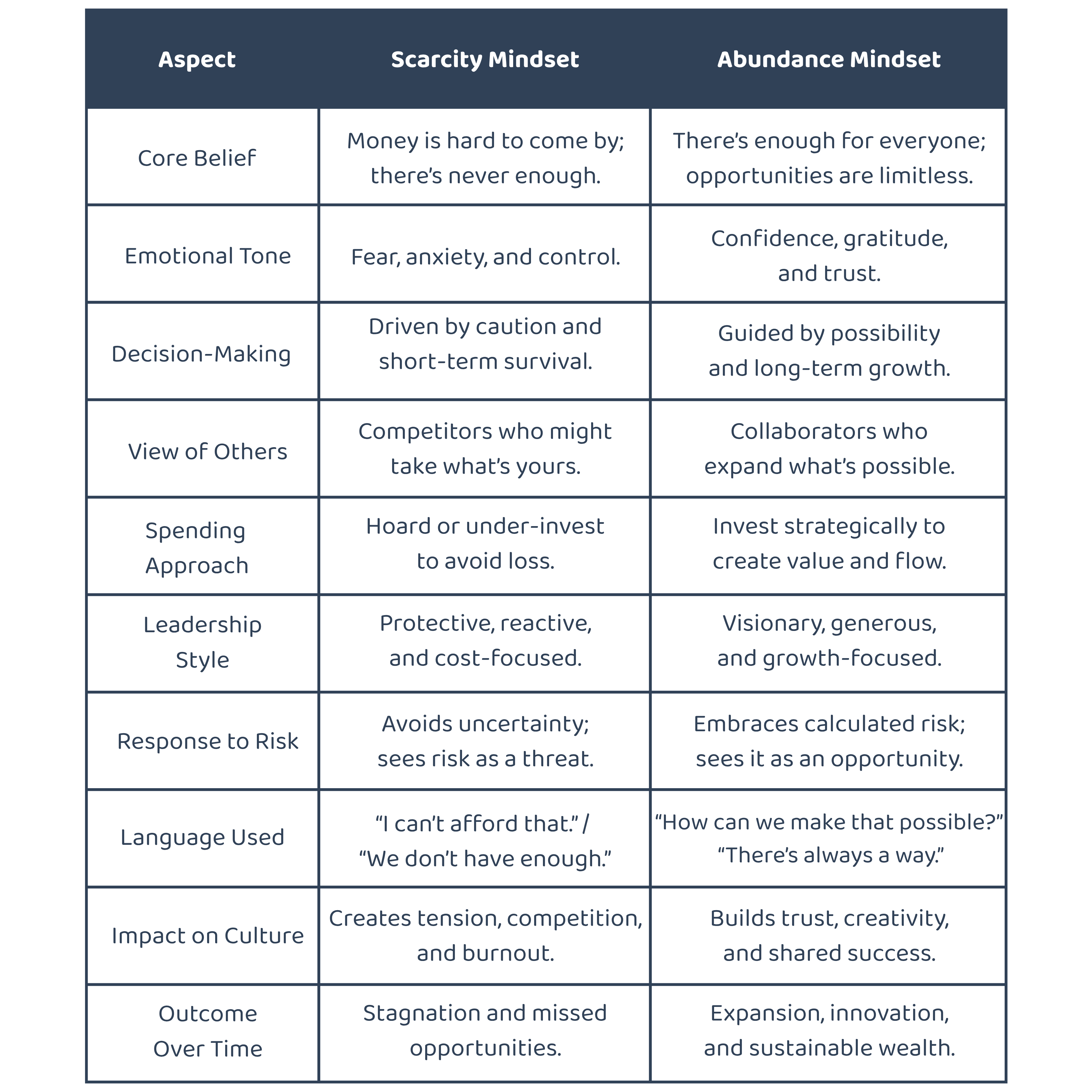
Money isn’t just numbers; it’s meaning. For some people, it represents security. For others, freedom. For many, it’s a measure of success or self‑worth. But money in and of itself is neutral; it’s our interpretation that gives it power.
Ask yourself:
What does money represent to me?
Do I see it as a tool or a test?
Do I use it to create options or to prove something?
When you start viewing money as a resource rather than a reward, your relationship with it changes. You stop chasing it and start directing it. You begin to make decisions that align with your values, not your fears.
Rewriting the Narrative
If you grew up with scarcity messages, shifting to abundance takes conscious effort. It’s not about ignoring reality, but reframing possibility.
Instead of “I can’t afford that,” try “How could I make that possible?”
Instead of “I’m not good with money,” try “I’m learning to manage money well.”
Language matters. Every phrase you use reinforces a belief. When you change the words, you start changing the mindset.
As a coach, I often see talented professionals who excel technically but struggle financially—not because they lack skill, but because they haven’t redefined their relationship with money.
A Conversation Worth Having
Money touches every part of life, our choices, our relationships, our sense of possibility. Yet for some people, it is rarely talked about. What if we did? What if we treated money conversations not as taboo but as opportunities for learning and growth, and a way to accelerate achievement? What if it started at the dinner table with the kids?
For me, money represents freedom and choice. It's the ability to design my life and business aligned with purpose. For you, it might mean security, impact, or legacy. Whatever it means, don't you think it’s worth exploring?
So, what’s your relationship with money?
How did your upbringing shape it?
And how might reframing your mindset open new possibilities for your business and your life?
If you are open to sharing your experiences, I would love to hear from you.