What Comes After Resilience?
Resilience is a word that’s been bandied around for years — in leadership circles, government programs, and community initiatives. It’s become a kind of badge of honour: the ability to bounce back, to keep going, to endure. But lately, I’ve been asking a different question: what happens after resilience? What comes next, once you’ve already proven you can survive?
Defining Resilience
At its core, resilience is the capacity to recover quickly from difficulty, to adapt, to bend without breaking. Psychologist Ann Masten (2001) famously called it “ordinary magic”, the everyday ability to cope, adjust, and continue functioning despite adversity. In business and farming contexts, resilience means staying operational through droughts, market shifts, or personal setbacks. It’s what keeps you going when conditions are tough.
But resilience isn’t just endurance. It’s also adaptability the ability to change course when the old way no longer works. True resilience involves learning, not just surviving. It’s the difference between bouncing back to the same place and bouncing forward to a new one.
Degrees of Resilience
Resilience exists in degrees. It’s not a fixed trait but a continuum that varies across people, situations, and time.
Psychologists (Luthar et al. 2000) describe resilience as a dynamic process, not a permanent state. You might show high resilience in one domain (say, business decision‑making) and lower resilience in another (like emotional recovery after loss). The degree depends on factors such as:
Internal resources — mindset, optimism, emotional regulation, and self‑belief.
External supports — relationships, community, and access to help.
Context and duration of stress — short‑term challenges draw on different reserves than long‑term adversity.
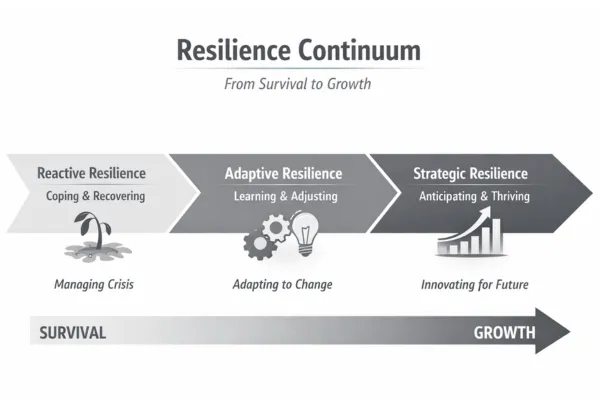
In farming and business contexts, you might think of resilience as a spectrum:
At one end, reactive resilience — coping and recovering.
In the middle, adaptive resilience — learning and adjusting.
At the far end, strategic resilience — anticipating, innovating, and thriving through change.
Resilience isn’t about being unbreakable; it’s about how flexibly and sustainably you respond to pressure over time.
The Resilience–Burnout Paradox
Here’s the tension: the very people who are most resilient are often closest to burnout. Farmers, business owners, and leaders who pride themselves on “pushing through” can end up running on empty. They’ve mastered endurance but forgotten recovery.
Resilience without renewal becomes depletion. You can be too resilient, too good at carrying the load and miss the signals that it’s time to rest, delegate, or change direction.
That’s why the correlation between resilience and burnout deserves attention. Burnout isn’t a failure of strength; it’s often the result of strength overused. The same qualities that make someone resilient can, without balance, lead to exhaustion and, in some cases, chronic traumatic stress. Australian studies like University of Newcastle and Beyond Blue’s National Rural Mental Health Survey (2021) found elevated rates of anxiety, depression, and trauma symptoms among farmers following droughts and bushfires. These experiences are not signs of weakness; they’re physiological responses to sustained adversity.
The Business Context
I work with many business owners, and a large number are farmers. They hear the word “resilience” constantly, from government departments, industry programs, and leadership workshops. These initiatives are valuable, but they often start from the assumption that farmers need resilience training.
In reality, most farmers already have resilience in spades. They’ve lived through, and some farmers are currently living through, droughts, floods, market collapses, and generational transitions. They’ve survived. The question isn’t whether they’re resilient, it’s how they move along the resilience continuum. What they do after the initial resilience. How do they move from coping to thriving?
What Comes Next
Renewal. It's the deliberate act of restoring energy, purpose, and perspective. Renewal is what moves you from reactive resilience to strategic resilience. It’s the shift from “getting through” to “growing through” and that is where you accelerate achievement.
Renewal involves some key transitions:
From endurance to intention.
Instead of just surviving tough seasons, ask yourself: What did this teach me? What will I change next time? It’s about learning through the experience. I have heard a lot of farmers in the last couple of weeks say to me how this drought is different for them from the last one. The lessons they learned have altered their strategy for managing this time.From going it alone to connection.
Resilient people often pride themselves on independence. Renewal invites connection and sharing with other people. Farming, by its very nature, can be isolating. When times are tough, we need to ensure we stay connected, as that connection is vital to our mental health and well-being. We need to find ways to increase connection even when geography limits it.
The Real Question
How do you look after yourself and your business after an intense period of resilience?
I would love to hear your insights.
Reference
Luthar, S. S., Cicchetti, D., & Becker, B. (2000). The construct of resilience: A critical evaluation and guidelines for future work. Child Development, 71(3), 543–562. https://doi.org/10.1111/1467‑8624.00164
Masten, A. S. (2001). Ordinary magic: Resilience processes in development. American Psychologist, 56(3), 227–238. https://doi.org/10.1037/0003-066X.56.3.227
University of Newcastle & Beyond Blue. (2021). National Rural Mental Health Survey: Understanding mental health in farming communities. Beyond Blue Australia. Retrieved May 28, 2026, from https://www.beyondblue.org.au