How Do You Use Values to Shape Your Culture at Work?
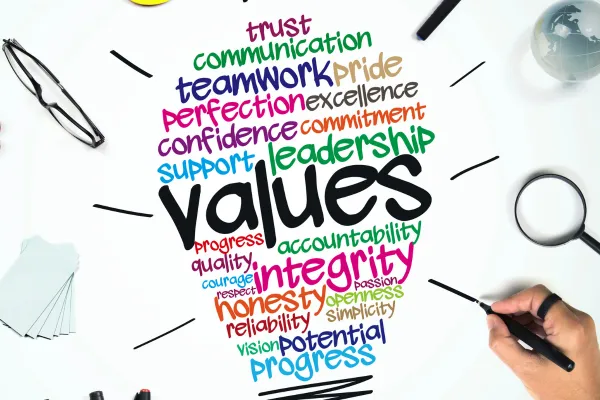
Values play a critical role in shaping workplace culture, yet they are often misunderstood or poorly defined. In my daily conversations with business owners, many confidently state that they are a “values-driven organisation.” However, when asked to articulate those values, they commonly provide a list of abstract nouns such as integrity, honesty, trust, teamwork, and discipline. While these words sound positive, on their own they lack clarity and meaning. Without shared definitions, values become open to individual interpretation, which can lead to confusion and inconsistency, between employees and all levels of business.
As Richman (2015) explains in The Culture Blueprint, values are only powerful when they are lived and experienced through everyday behaviours, not when they are displayed as words on a wall. Richman argues that values should function as a decision-making compass, guiding how people act when no one is watching. When values remain as vague nouns, employees are left to fill in the gaps themselves, often based on personal beliefs and experience rather than organisational intent.
Take honesty as an example. One employee may interpret honesty as always telling the blunt truth, regardless of the impact it has on others. Another may assume it refers to ethical behaviour, such as not stealing from the business. Both interpretations are reasonable, yet they can lead to very different outcomes. Blunt honesty may damage relationships and create tension, whereas ethical honesty relates more to trust and integrity. The issue is not the value itself, but the lack of clarity around its meaning and why it is important to the business.
Richman (2015) suggests that values should be written as clear behavioural statements rather than abstract labels. For example, instead of stating “honesty” as a value, an organisation might say, “We value honest and open feedback when its delivered with respect.” This removes ambiguity and makes the value actionable. It clearly communicates that feedback matters, while also setting expectations around how that feedback should be given.
The same challenge applies to values such as discipline. For some, discipline may imply punishment for mistakes or a rigid, work environment where there is no fun or laughter. For others, it may mean consistency, follow-through, and accountability. Without clarity, discipline can quickly become a source of fear rather than a driver of high performance. When reframed behaviourally—such as “We follow through on our commitments and hold ourselves accountable”—discipline becomes a positive and empowering standard.
Over time, this consistency of lived values builds trust, strengthens relationships, and creates a culture where people feel safe, clear, and engaged.
In spirit, values are not what a business says it believes in; it is what people experience daily. By moving from one-word nouns and translating values into clear, statements, leaders can intentionally shape a culture that supports both performance and healthy relationships at work.
How do you give meaning to your values?
I would like to hear about your experience with values and how they are used to shape your workplace culture.
References
Richman, R. (2015). The culture blueprint: A guide to building the high-performance workplace. Culture Hackers.