Decision Making: Turning Uncertainty into Direction
Summary
Decision-making is one of the most repeated yet least mastered skills in business. This article introduces a practical five‑step model that helps leaders move from uncertainty to clarity, ensuring decisions are grounded in direction, data, and disciplined review.
Why Decision Making Feels Hard
Decision-making becomes difficult when direction is missing. Without a clear plan and/ or goals, every choice feels like guesswork. Businesses often stall not because they lack options, but because they haven’t defined what success looks like. When the future is uncertain, decisions feel risky and emotional rather than strategic.
Take the example of a farmer heading into a dry winter. Feed is scarce, diesel prices have jumped, and the question looms: Do we sell stock or hold and feed? Without a clear business direction, the decision becomes reactive. But with a defined goal (for instance, consistent production, consistent revenue), the choice becomes clearer. Direction turns uncertainty into criteria.
“You cannot make progress without making decisions”
(Jim Rohn, Entrepreneur, motivational speaker and author of fifteen books)
The Decision Clarity Model
A practical way to approach decisions is through the Decision Clarity Model, a five‑step process that works across industries and scales—from small business owners to corporate teams.
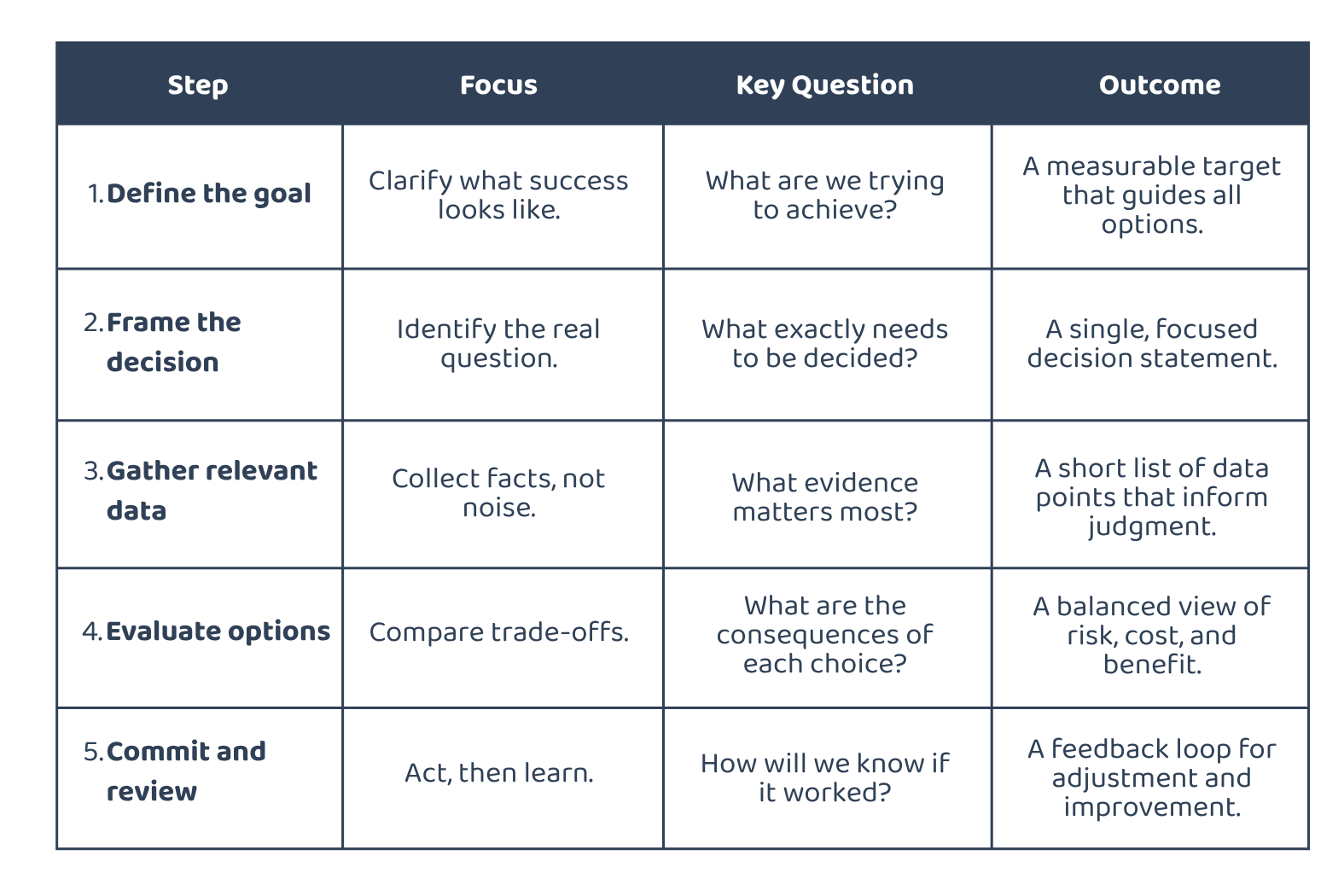
This model keeps decisions practical and forward‑looking. It prevents paralysis by forcing clarity at each stage—goal, question, evidence, options, and learning.
Applying the Model in Business
Define the goal before the meeting. Many decisions derail because teams debate tactics without agreeing on the destination. Start every decision conversation with a one‑line goal: “We’re deciding how to maintain profitability through Q4.” That single sentence anchors discussion.
Frame the decision tightly. Avoid vague questions like “What should we do?” Instead, ask “Should we expand production now or wait until demand stabilises?” A well‑framed decision narrows focus and reduces emotional noise.
Use data windows, not data floods. Decision makers often drown in information. Choose a relevant time frame—say, the last six months of sales or the next quarter’s forecast—and ignore the rest. Data should inform, not overwhelm.
Compare options side by side. List two or three viable paths and their implications.
Option A: Sell stock early—reduces feed cost, limits revenue upside.
Option B: Hold and feed—maintains herd quality, increases short‑term cost. Seeing trade‑offs visually helps teams move from debate to decision.
Commit and review. Every decision should have a review point. Set a date to check results and make adjustments. This turns decision making into a learning system rather than a one‑off event.
The Human Side of Decision Making
Even with a model, decisions are influenced by emotion, bias, and fatigue. Leaders often fall into predictable traps—confirmation bias, sunk‑cost fallacy, or overconfidence. My article on Active listening has a great section on bias. The antidote is awareness and structure. Simple rituals like writing down assumptions, inviting dissenting views, and running quick pre‑mortems (“What could make this fail?”) keep decisions grounded in reality.
From Reaction to Strategy
The best decision makers aren’t faster—they’re clearer. They slow down just enough to define the goal, frame the question, and test assumptions before acting. In business, clarity beats speed every time. When direction is set, even tough calls, whether to invest, hire, or pivot, become manageable.
Bottom line: Decision-making isn’t about predicting the future; it’s about shaping it with intention. A clear goal, structured process, and disciplined review turn uncertainty into progress. Every decision, big or small, becomes a step toward the business you’re deliberately building and that is how you accelerate achievement.