Active Listening
In everything I do and with everyone I work with, one of the most important skills in business and leadership (and life) that we talk about and work on is active listening.
Active listening is the single most practical leadership skill for reducing costly misunderstandings and unlocking better decisions; it requires deliberate habits (pause, paraphrase, probe) and active management of our bias. Practised across teams, it improves trust, problem‑solving and resilience in tough business environments like we are experiencing at the moment.
Active listening means more than hearing the words that are spoken. It is giving the speaker your full attention, a reflective response, and verification of what they said. It is also about what is not being said, what their body language and energy are also telling you. It is listening without judgment. In the workplace, active listening enhances communication, builds trust and cohesion, improves problem-solving and increases productivity.
“One of the most sincere forms of respect is actually listening to what another has to say.” — Bryant H. McGill.
Our own biases are one of the main obstacles to active listening. Don't worry, we all have them. Basically, a bias is a perceptual error. These are flaws in our perception caused by mental shortcuts we use to simplify information. A bias forms because our brain uses fast mental shortcuts (heuristics) to save time and energy. Our individual experiences, emotions and memories shape these shortcuts, and they are the filter through which we interpret information.
There are several types of biases:
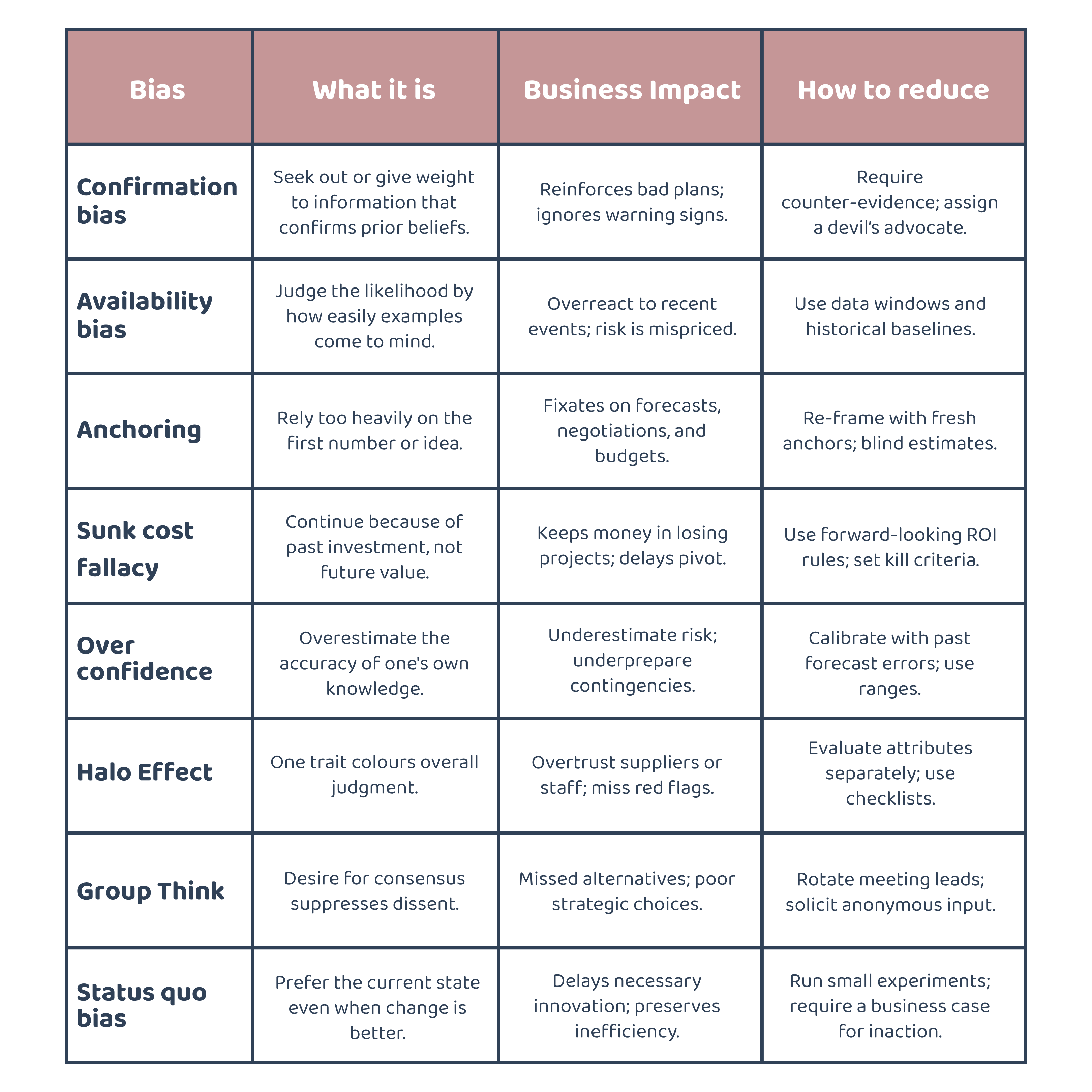
Bias is normal, but it needs to be managed so that we don't jump to conclusions and make errors. We can do this by making our assumptions explicit, seeking differing opinions, and considering the decision from all angles. By slowing down our decision-making, we can convert our intuition into reliable data.
Missing information from poor listening is often the most expensive loss. Teams lose nuance about constraints, hidden risks, and creative workarounds when leaders jump to conclusions and race for solutions.
To embed active listening in practice, adopt simple routines: require paraphrase summaries, flag and test assumptions, and build feedback loops that let staff/ others correct misinterpretations (without penalty). Active listening is also measurable. You can track things like fewer reworks, faster decision cycles, and improved staff engagement.
Active listening is not a nice-to-have— it is a measurable leadership competency that builds trust and team cohesion, reduces risk, surfaces hidden information, increases problem-solving and ultimately productivity. In tough times, when margins are thinning, active listening becomes a competitive advantage and is yet another way to accelerate your achievement.
I would love to hear from you.